Get Shit Done University, since 10,000 b.c.
Stop overthinking. Start getting shit done.
Learn to sell, negotiate and execute from Master Business Coach Dan Creed: over 45 years, more than 400 business turnarounds, and a Lifetime Achievement Award for coaching excellence.
 Taught byMaster Business Coach Dan Creed

Lifetime Achievement Award
Coaching excellence, FocalPoint International, 2024
Top 10 Transformational Coaches
Globally, CXO Outlook
7× Brian Tracy Award
For sales excellence
International Coach of the Year
FocalPoint International

Meet the Dean of Execution
Every course is taught by one of the most decorated business coaches in the world.
Dan isn't a speaker with a framework to sell. For over 45 years he has built businesses, fixed them, and coached owners and executives through the same problems you're facing.
- Built a seven-figure coaching business of his own.
- Took one client from $3.5 million to $42 million in under five years, and another from $1.5 million to $13 million in four.
- Launched or helped launch 17 startups, some bootstrapped and some funded, and led more than 400 turnarounds.
- Mentored by Brian Tracy, then won Brian Tracy’s own award for sales excellence seven times.
- Sat on the acquisition and negotiating teams of publicly traded companies.
- Author or co-author of eight books, including the certified best seller Champions Never Make Cold Calls.
- Named one of the Top Ten Transformational Coaches globally by CXO Outlook.
45+
Years of startups and coaching
~17,000
Hours of logged coaching
400+
Business turnarounds
7×
Winner of the Brian Tracy Award for Sales Excellence
In his clients’ words
“Danny will push you further than you ever thought you could go. Whether you are a start-up or just looking to rejuvenate, Danny is the coach you must have on your team.”
Tyler RobinsonLeadership Coach, ROCK Solid Coaching & Consulting “He's a straight-shooter, so he won't waste your valuable time by sugar-coating a situation. He will tell you what you need to hear to get results.”
Brian KellyFounder, Reach Your Peak LLC; Host, Mind Body Business Show “His simple, yet effective systems to productivity have helped me create clarity and direction for my goals. Content that is easily digestible and can be applied immediately.”
Anthony LopezVoluntary Benefits Consultant
Follow Dan on social.
Lessons, hot-seat moments and straight talk from Master Business Coach Dan Creed, between courses.
- LinkedInFollow
- FacebookFollow
- InstagramComing soon
Dan’s flagship program
Selling Coaching
How non-selling coaches become deal closers
The complete sales system for coaches who hate selling. From getting the appointment to negotiating the deal.
See the full syllabusThe Course
$997
The complete course, on demand, yours for life.
- All 26 episodes and 13 modules
- Workbook, cheat sheet and Blueprint reference
- Lifetime access, at your own pace
Most popular
The Inner Circle
$1,497
The course plus twelve months of live monthly coaching with Dan.
- Everything in The Course
- 12 months of live monthly hot-seat sessions
- Submit your situation for Dan to work on live
- Every session recorded, replays yours to keep
The Cohort Intensive
$2,497
Ten weeks of live teaching with Dan, in a cohort capped at ten coaches.
- Everything in The Inner Circle
- 10 weekly live sessions, taught in order
- Bring real prospects; Dan works them in the room
- Capped at 10 coaches per cohort
Per seat. Closes when the cohort fills.
Enroll for $2,497The core curriculum
Dan’s playbook, one skill at a time.
Each course is $49, with worksheets, knowledge checks and lifetime access.
Explore this course
Most deals aren't lost. They're talked to death.
You know the feeling. The conversation was going well. They were nodding. And then somewhere in the next ten minutes it slipped away, and you still couldn't tell you exactly where.
Two things usually did it. You were pitching the same way to everyone, without knowing who was actually across from you. And when the yes finally arrived, you kept selling straight through it.
Closing isn't a personality trait and it isn't a trick. It's a sequence you can learn, and it works the same whether you're pitching a client, asking for a raise, or getting a teenager to agree to something before midnight.
Two parts. Fifteen minutes each.
- IntroductionCourse introWhat this actually is, what you'll walk away with, and how to use it. Watch the two parts in order, then take the toolkit into a real conversation this week. The reps are the point.
- Module 1Read the roomBefore you can sell anyone anything, you have to know who you're talking to. The sales psychology that separates closers from talkers, and the DISC framework in plain English so you can read any buyer in about sixty seconds and adapt on the fly.
- Module 2Get the yesThe Stacking Bricks method — five micro-yeses that turn the final ask into the next logical step instead of a leap. Plus a library of trial closes in your own voice, and the discipline to stop selling and let the deal close itself.
- ResourcesCheat sheet & workbookA printable cheat sheet for before the call, and a fillable workbook for the reps that follow. Both yours to keep.
Half an hour. Whole career.
Printable
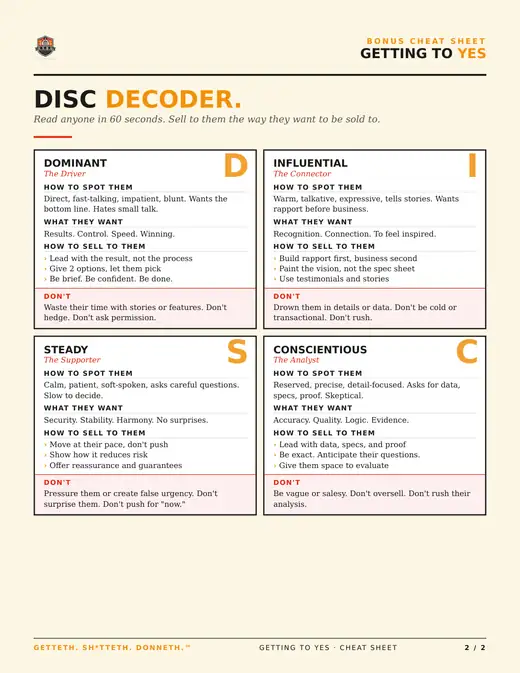
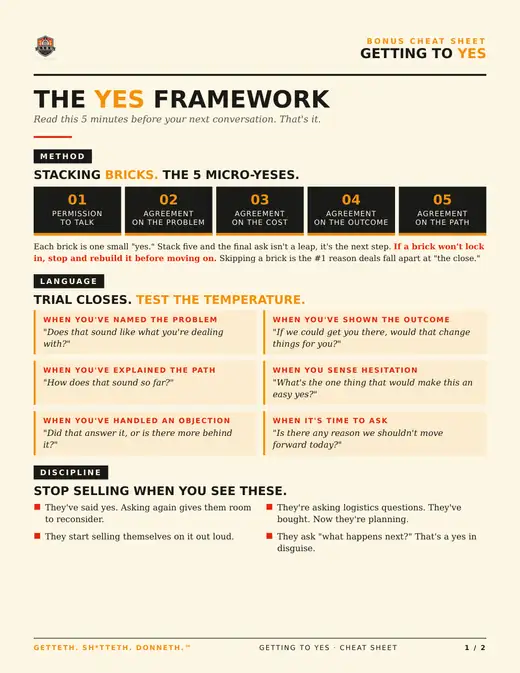
The cheat sheet
One printable page for before the call — the buyer types, the stacking sequence, and the trial closes worth memorizing.
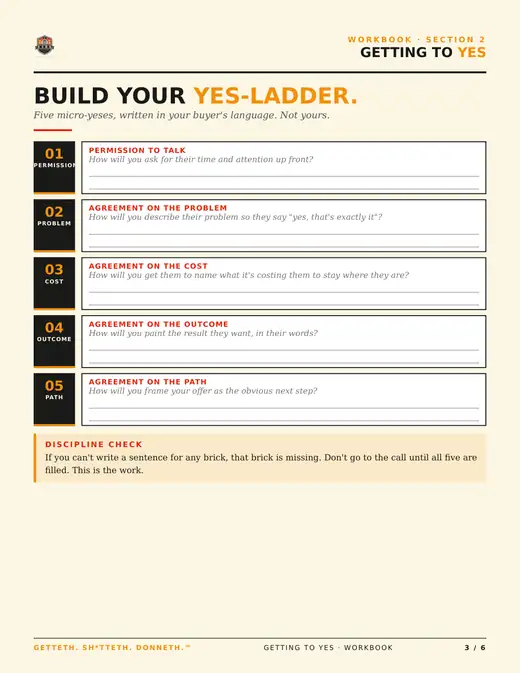
Fillable
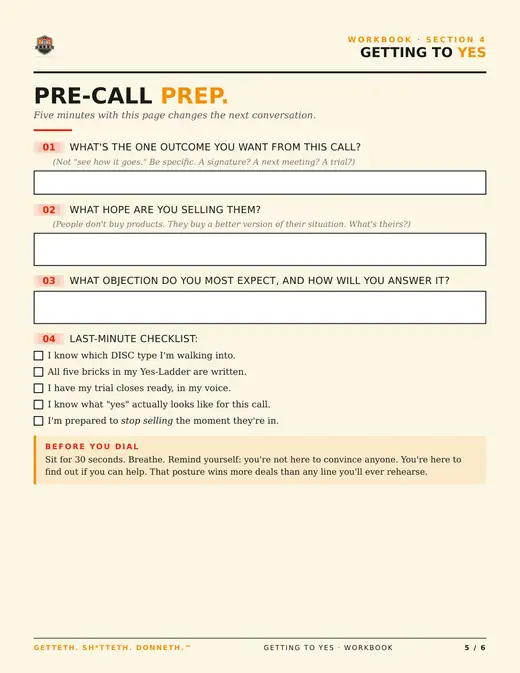
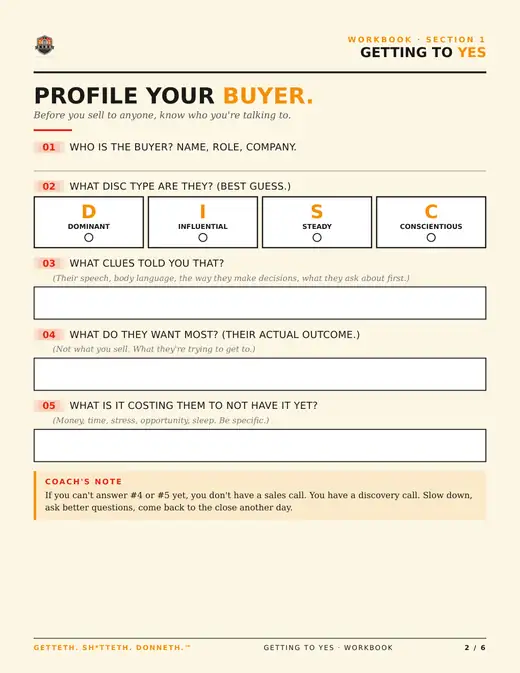
The fillable workbook
Where you build your own trial closes in your own words, so they sound like you and not like a script.
Also included
Two video parts
Fifteen minutes each, watched in order. Short enough to finish in a lunch break and yours for life to come back to.
Knowledge checks
A short self-graded quiz after each part, so the sequence sticks before you take it into a room with someone.
Master Business Coach Dan Creed
Dan Creed has spent 19 years as a professional business coach, building a seven-figure coaching company from the ground up — without ever giving an elevator pitch.
He's coached thousands of coaches across every discipline — life, business, executive, performance — and the number one issue he sees, everywhere in the world, is the same: brilliant coaches who can't make a living because they don't know how to sell.
Nothing in this course is theoretical. It's been tested on the phone, in the boardroom and across the kitchen table, alongside people like Brian Tracy. It's the shortest thing GSDU teaches and the one you'll use the soonest.
Frequently asked
Who is this course for?
Anyone who has to get another person to agree to something. Master Coach Dan is explicit that the framework is the same whether you're pitching a client, negotiating a raise, or trying to get your kid to bed without a war.
How long does it take?
About thirty minutes to watch — two parts, fifteen minutes each. Then download the toolkit and use it on a real conversation this week, even a small one. The reps are the point.
Do I need a sales background?
No. It's taught as plain mechanics rather than sales jargon, and the DISC framework is explained from scratch. If anything it lands harder on people who've never thought of themselves as sellers.
How is this different from Selling Coaching?
This is the thirty-minute version of one specific skill: closing. Selling Coaching is the full system for building a coaching practice — 26 episodes, live group calls, the whole thing. Start here if you want the closing framework on its own.
How long do I have access?
For life. One payment, and both parts plus the cheat sheet and workbook stay in your GSDU library.
How do I get in after I buy?
You'll get a welcome email straight after checkout with your login and a link. Everything lives in your GSDU library and you can start Part One within a minute of enrolling.
Enroll for $49The deal was never lost. You just kept talking.
Thirty minutes from now you'll know how to read the person in front of you, build the yes one brick at a time, and recognize the moment to stop. Use it on your very next call.
Explore this course
You are being tuned out.
The average adult attention span is now under seven seconds. A goldfish does better. So when you explain, pitch, present or persuade, most of it never lands — not because your case is weak, but because nobody needs to be told anything anymore.
Meanwhile the person across from you is waiting for something almost nobody gives them: a real question, followed by silence. Master Business Coach Dan Creed has spent a career watching what happens in that silence. People tell you extraordinary things. They tell you exactly what they need. They tell you, in effect, how to sell them.
This course is the system for getting into that silence on purpose — and knowing what to do once you are there.
Sixteen rules, four episodes.
- Episode 1Ask, don't tell: rules 1 to 4Why questioning is a deliberate strategy, not a courtesy. Pay attention. The questioner has control. Shut up and listen. And the 10/90 Rule — you talk a tenth of the time, they talk the rest.
- Episode 2Holding your tongue: rules 5 to 10Never interrupt — and the one exception. Pick your battles. Take lots of notes, and ask permission first. Why pouncing on the first opportunity costs you every other one underneath it.
- Episode 3Don't judge, give back: rules 11 to 16Why you must never become your opponent's conscience or their bookkeeper. Gratitude, admiration and approval — and how to turn a page of notes into a needs, issues and opportunities list.
- Episode 4You told me: closing by listeningThe phrase you have to earn, the one-for-one close, and the two small questions that surface everything they forgot to tell you. Done properly, the close stops being the frightening part.
- PlusKnowledge checks & downloadsA knowledge check after every episode, plus three printable companion resources you can keep beside you in a live conversation.
Everything you take with you.
Four full episodes
All 16 Rules of Questioning, taught in order, with the stories and the exact words to use. Watch at your own pace, revisit whenever a big conversation is coming.
The 16 Rules cheat sheet
Every rule on one printable reference, grouped into the posture, the discipline and the generosity. Keep it in your notebook and read it in the car before you walk in.
The live worksheet
The needs, issues and opportunities page you actually write on during the meeting — plus the match-up grid that turns those notes into a close.
The question bank
Every script from the course, written out word for word — opening, validating, refusing the argument, reviewing, and closing. Short enough to use under pressure.
Master Business Coach Dan Creed
Master Business Coach Dan Creed has spent nearly two decades coaching business owners and leaders, and built a seven-figure coaching practice himself without ever giving an elevator pitch. He is also Dean of GSDU.
His position on selling is unusual and, once you hear it, hard to argue with: the pitch is the problem. People can smell one coming, and it puts their guard up before you have said anything worth hearing. Replace it with a genuinely good conversation and the resistance never appears.
This course is the questioning half of that system — the part that works whether you are closing a deal, asking for a raise, buying a car, sitting with your child's teacher, or trying to understand what your own team actually needs.
Frequently asked
Is this only for salespeople?
No. The rules work identically in a job interview, a supplier negotiation, a performance review, a parent-teacher meeting or a difficult conversation at home. If it involves another human deciding something, it applies.
How long does it take?
It is deliberately short — four episodes you can finish in an afternoon. Everything in it is usable in the next conversation you have, not next quarter.
How is this different from a sales course?
Most sales training teaches you what to say. This teaches you what to ask, and then what to do in the silence afterwards. There is no pitch in it anywhere — that is rather the point.
Do I need any other GSDU course first?
Not at all — it stands completely on its own. If you want to go further afterwards, Negotiation 101: How to Negotiate Anything picks up once you are at the table, and Getting To Yes goes deeper on the psychology of small approvals.
How long do I have access?
Lifetime. Buy once, come back to it before every big conversation for as long as you like.
Enroll for $49Ask. Then shut up and listen.
Questions are the beginning and the ending of success at all levels. Sixteen rules, four episodes, and a conversation you can have tonight.
Explore this course
Everybody's talking. Nobody's listening.
Six people at a dinner table and every one of them is looking at a phone. You're mid-story and you've already lost the room. Master Coach Dan puts the working attention span at about five to seven seconds, and if you fade after seven seconds in a conversation that actually matters, you're in trouble.
Meanwhile everybody's still leading with “let me tell you something.” But information is instant now. Nobody needs to be told anything, and telling people things is the fastest way to start an argument you didn't want.
What people want is to be heard. Almost nobody does it. Which is exactly why doing it well is an unfair advantage, whether that's in a negotiation, in a hiring conversation, or at your own kitchen table.
4 modules. 4 episodes. 18 rules.
- Module 1The lost art of listeningWhy “tell” is an argumentative word, why the elevator pitch is dead, and the three most powerful words in any conversation. Plus the four voices in your head that stop you hearing a thing.
- Module 2Questions & the first six rulesThe core loop, which is ask, shut up, listen, write it down, validate, then ask “what else?” Plus rules one through six, including the 10/90 rule that changes how the first meeting goes.
- Module 3The rules that change everythingRules seven through seventeen: clarifying and confirming, holding the empty space, the one word you should never use, and why pouncing costs you the trust you just built.
- Module 4Rule 18 & putting it to workThe last rule, the one nobody wants to hear, and then the part that decides whether any of it mattered: how to recover when you get caught drifting, and how to actually use what people tell you.
- ResourcesCheat sheet & companion workbookAll 18 rules on one printable page, and a workbook with the self-audit, the 10/90 tracker, the question bank and a prep sheet for your next real conversation.
Short course. Long shelf life.
Four video episodes
Master Coach Dan teaching the whole system end to end. Short enough to finish in an afternoon, and yours for life to come back to.
The 18 Rules cheat sheet
Every rule on one printable page, with the core loop and the phrases worth memorizing. Keep it in the notebook you carry into meetings.
Companion workbook
The honest self-audit against the four sabotaging voices, the 10/90 tracker, the question bank, and a one-page prep sheet for your next real conversation.
Knowledge checks
A quick self-graded quiz after every module, so the rules stick before you take them into a room with someone.
Master Business Coach Dan Creed
Dan Creed has spent 19 years as a professional business coach, building a seven-figure coaching company from the ground up — without ever giving an elevator pitch.
He's coached thousands of coaches across every discipline — life, business, executive, performance — and the number one issue he sees, everywhere in the world, is the same: brilliant coaches who can't make a living because they don't know how to sell.
Underneath all of it sits one skill he's been practicing for over 45 years, in front of executives, business owners and people who came to him with something hard to say. This course is that skill, taken apart and handed to you. Not theory. Not motivation. Eighteen rules and a loop you can use in your next conversation.
Frequently asked
Who is this course for?
Anyone whose results depend on other people. Master Coach Dan is explicit that this applies from grade school to the boardroom, so that covers sales, coaching, management, hiring, parenting and marriage. If you sit across from people and need to understand what they actually need, it's for you.
How long does it take?
One afternoon to watch, the rest of your career to use. Four episodes, four knowledge checks, and two downloads. It's deliberately short, because this is a skill you practice, not a library you work through.
How long do I have access?
For life. One payment, and the episodes and downloads stay in your GSDU library.
I already own Selling Coaching. Is this a repeat?
No. Selling Coaching introduces listening as one module inside a larger selling system. This is the full treatment: all 18 rules, the complete loop, and the material Dan didn't have room for there. They work well together, and neither one needs the other.
I'm not in sales. Does it still apply?
Yes. Dan teaches it as a life skill first and a business skill second. The rules don't change depending on who's across the table. The person could be a prospect, an employee, your teenager, or your spouse.
How do I get in after I buy?
You'll get a welcome email straight after checkout with your login and a link. Everything lives in your GSDU library and you can start the first episode within a minute of enrolling.
Enroll for $49Be the one person in the room who's actually listening.
Listen closely enough and you earn the right to say the three most powerful words in any conversation: you told me. Everything changes after that.
Explore this course
Most people sabotage themselves out loud.
I'll give it a shot. I hope I can. Maybe. I'll try. I'm okay, just getting by.
None of those sound like a problem. That's exactly why they're one. Every single one is an escape hatch, and the person listening hears it whether they can name it or not.
Around 90% of how you're perceived comes from how you speak and how you act. Most people have never once audited what they're actually saying — to a room, to a client, or to themselves.
Three episodes. One shift.
- Episode 1Survival mindset vs. possibility mindsetWhere the whole idea comes from, the exact phrases that give each mindset away, the three rules of a possibility vocabulary, and the one-word change that got a lifelong smoker to quit without trying to.
- Episode 2Power communication and the four personalitiesWhy this has to show up in every channel you use, not just the ones where you're performing. Then the four personality types, and the single power word that lands with each one.
- Episode 3Making the shift permanentWhy it's contagious in both directions, what it costs to stay in the wrong room, the sentence a leader uses to give people hope, and the bank president who hired Master Coach Dan without ever hearing a pitch.
Everything in one place.
Three video episodes
The complete course, taught start to finish by Master Business Coach Dan Creed. Watch it in a single afternoon.
A knowledge check per module
Short quizzes with a full answer key, so what you just watched actually sticks before you move on.
The quick reference
The swap list, the three rules, the words of confidence, and the power words for each personality — on one page.
The seven-day reset
One short practice a day for a week. Nothing takes more than a few minutes, and by day seven it's a habit.
Master Business Coach Dan Creed
Dan Creed has spent 19 years as a professional business coach, building a seven-figure coaching company from the ground up — without ever giving an elevator pitch.
He's the Dean of GSDU, and he's taught this material to audiences all over the world for years. It's one of his favorites, and the one he most often hears back about years later.
Not theory. Not motivation. Just a specific, repeatable change to what comes out of your mouth.
Frequently asked
How long does it take?
One afternoon for the three episodes. The Seven-Day Reset then runs a few minutes a day for a week, once you've finished watching.
Is this only for people in business?
No. It lands hardest if you lead, sell or own something, but it applies to interviews, parenting, leadership and how you talk to yourself. Dan teaches it to every kind of audience.
Is this just positive thinking?
No. It's a specific set of rules about tense, phrasing and word choice, with a list of exactly what to stop saying and what to say instead. You can apply it the same day.
How long do I have access?
For life. One payment, and it stays in your GSDU library to revisit whenever you want.
Do I need to have taken another GSDU course first?
Not at all. It stands completely on its own, and it's a good first course if you haven't taken one before.
Enroll for $49Change what you say. Change what opens.
Someone's always watching, and someone's always listening. The only question is what they're hearing.
Explore this course
That isn't negotiating. That's discounting.
Someone says your price is too high. You ask what they would pay. That is not a negotiation — it is a discount with extra steps, and it teaches everyone that asking is enough.
Master Business Coach Dan Creed once walked into one of the largest advertising agencies in the world. The buyer looked at his proposal and said the price was too high. He said, “I'm sorry, I guess we can't do business” — and she stopped him on the spot.
The agency had researched it. Over ninety percent of salespeople drop their rate the instant it is challenged, with no conversation at all. So every buyer was trained to open with exactly that line. She told him she would probably buy from him — precisely because he had stood behind his number.
Negotiation is the process of achieving agreement through discussion. This course is how that is actually done.
Twelve rules, four episodes.
- Episode 1Everything is a negotiationThe three phases and the four preparation steps. Never accept a no from someone who cannot say yes. And how to read whether you are dealing with a driver, an expressive, a steady or an analytical — because approach them wrong and you never earn the right to negotiate at all.
- Episode 2Information is leveragePrice is rarely the real issue. Write it down, set it aside, and ask what else. The first negotiation is rarely the only negotiation — and whoever has the most information controls the room.
- Episode 3Trading and concessionsNegotiate the little things first, lowest priority to highest. Know what you will give up before you sit down. Never lower anything without asking for something back. And why the walls have ears.
- Episode 4Knowing how it endsYour exit strategy and your walk-away point, both decided in advance. Then the four possible outcomes — and why only one of them is worth accepting.
- PlusKnowledge checks & downloadsA knowledge check after every episode, plus three printable resources including the preparation worksheet you fill in before you walk in.
Everything you take with you.
Four full episodes
All twelve rules taught in order, with the stories behind them — the advertising agency, the appliance showroom, and the elevator with the listening device.
The 12 Rules cheat sheet
Every rule on one printable reference, plus the three phases and the four possible outcomes. Review it before anything that matters.
The prep worksheet
The four preparation steps as a page you fill in before you walk in — their priorities, your goals, what you will trade, and your walk-away point.
Companion workbook
The scripts written out word for word, plus exercises that walk you through your own next negotiation one episode at a time.
Master Business Coach Dan Creed
Master Business Coach Dan Creed has negotiated deals in eighteen and nineteen countries, with billion-dollar companies and with startups, across nearly two decades of coaching business owners and leaders. He is also Dean of GSDU.
He has been on both sides of it — including the day he walked back from the restroom mid-negotiation, glanced into the room next door, and found the entire opposing team gathered around a speaker listening to his own team talk.
His rule has not changed in all that time: do not do deals with people who do not want to work with you. If it is not win-win, walk.
Frequently asked
I'm not in sales. Is this for me?
Yes. Most of us negotiate constantly without ever calling it that — a raise, a contract, a car, a house, a dispute, or getting your kids home by midnight. The rules are foundational, which means they scale in both directions.
Isn't negotiating just haggling?
No — and that confusion is what this course exists to fix. Haggling is two people moving a number. Negotiating is achieving agreement through discussion, where both sides give something and both sides would work together again.
How long does it take?
Four episodes you can finish in an afternoon. The preparation worksheet is usable in the very next negotiation you walk into.
Do I need another GSDU course first?
No, it stands on its own. It does pair naturally with The Art and Power of Questions — that course is the questioning that gets you to the table with the information you need, and rule five here is that whoever has the most information controls the negotiation.
How long do I have access?
Lifetime. Come back to it before every deal that matters, for as long as you like.
Enroll for $49Do we have a deal?
Great deals are available all day long if you are willing to make them great deals. Life is too short to fight about the price of something — and it is a game that starts with a conversation.
Explore this course
You can't manage time. Nobody can.
Master Coach Dan is blunt about it: if somebody tries to sell you a time management course, run away. Time management is the belief that you can do everything you think you need to do. In a digital world you cannot, and that thinking is extinct.
You already know the feeling. The day goes haywire before ten o'clock. The list gets longer, not shorter. It stacks up across the week and the month, and it follows you home. Working harder has stopped helping, because hours were never the thing being measured.
Peter Drucker saw it first: we're paid for accomplishments, not activities. Nobody cares that you worked a hundred hours. All that counts is the result — and if the result took a hundred hours, something else is wrong. What you can manage is your priorities. That's the whole course.
6 modules. 9 episodes. One system.
- Module 1Why priority management beats time managementThe promise, the Drucker principle, and the Eight Hard Questions you answer before you touch a single technique — starting with KWINCA: knowing what I now know, what would I start, stop or continue? Plus the one success skill recruiters, bankers and investors are actually hunting for.
- Module 2The mindset that makes it workWhy the system fails without the mindset behind it, how to name and cut the time vampires draining your week, and the discipline that buys back your freedom instead of costing it.
- Module 3What your time is actually worthThe number one priority management test. Work out your real hourly value, then measure every task against it. Once you know the number, the delegate-or-do decision stops being a debate.
- Module 4Plan tomorrow tonightEat that frog, and why the evening before is the highest-leverage ten minutes in your day. The most valuable use of your time, and the list that starts everything.
- Module 5The prioritization methodA, B, C, D, E — must, should, nice, delegate, eliminate, scored on consequence rather than on how loudly something is being asked for. Then finding your A1 and the rules that protect it. Dan's business owners consistently find half their week going on C tasks.
- Module 6King Solomon's rule and final thoughtsThe oldest decision rule there is, and how the whole system fits together into something you'll still be running a year from now.
- ResourcesFour printable worksheetsThe Eight Hard Questions worksheet, the Time Value Calculator, the Daily Priority Planner, and the ABCDE quick reference to keep beside your list.
A method, not motivation.
Nine video episodes
The complete workshop across six modules, taught end to end. Yours for life, so you can run the reset again whenever the week gets away from you.
The Eight Hard Questions
A worksheet for the questions that come before the system. Answer them honestly once and the rest of the course lands differently.
Time Value Calculator & Daily Planner
Work out what an hour of yours is genuinely worth, then plan tomorrow tonight on a single sheet built for the ABCDE method.
Knowledge checks
A short self-graded quiz after every module, so the method is in your hands before you take it into a working week.
Master Business Coach Dan Creed
Dan Creed has spent 19 years as a professional business coach, building a seven-figure coaching company from the ground up — without ever giving an elevator pitch.
He's coached thousands of coaches across every discipline — life, business, executive, performance — and the number one issue he sees, everywhere in the world, is the same: brilliant coaches who can't make a living because they don't know how to sell.
This particular workshop he's been teaching for thirty years, built on more than a thousand hours of research, and he calls it the first step in goal achievement. He's watched people working ninety-five hour weeks come down to fifty and get more done. Not theory. Not motivation. A method, and the worksheets to run it.
Frequently asked
Can I really double my productivity in 24 hours?
That's the promise Master Coach Dan makes, and he makes it on the condition that you apply exactly what's in the course. Most of the gain comes from the same place every time: recovering the half of the week that was going on tasks with no consequence attached to them.
How is this different from a time management course?
Time management assumes you can get everything done. This starts from the opposite premise — you can't, so the only real skill is deciding what actually matters and being willing to eliminate the rest.
Do I need to run a business for this to apply?
No. Dan teaches it to business owners, executives and employees alike, and the hard questions in Module 1 are about your life as much as your work. If you have more to do than hours to do it in, the method fits.
How long does it take?
Nine short episodes and six knowledge checks — an afternoon to watch. The worksheets are the part you keep using, and the planning habit takes about ten minutes an evening.
How long do I have access?
For life. One payment, and the episodes and worksheets stay in your GSDU library.
How do I get in after I buy?
You'll get a welcome email straight after checkout with your login and a link. Everything lives in your GSDU library and you can start the first episode within a minute of enrolling.
Enroll for $49Stop managing time you can't control. Start managing what you can.
You're paid for accomplishments, not activities. Tonight you can write tomorrow's list, mark every line A through E, and find out how much of your week was never worth having.
Explore this course
Someone is always watching.
Most people have never sat down and thought about the legacy they're leaving. Plenty of them push back on the idea altogether: I don't care what people think, I am who I am, what you see is what you get. In a digital world that attitude is expensive.
Because a perception is forming whether you're managing it or not. It's built from your reviews, your social profiles, the way you sound on a voicemail greeting, and word of mouth passed down a line of people who each change it slightly. What people perceive is what they believe, and almost nobody stops to ask for proof.
So here's the honest question. The perception you've allowed to form — is it working for you or against you? Because if you don't do anything about it, it follows you for a lifetime: into job interviews, into relationships, into every first impression you'll ever make.
3 modules. 5 episodes. 8 triggers.
- Module 1Perception is everythingWhy your legacy is a choice rather than an accident, where perception is actually built — the auditory and the visual, online before anyone meets you — and the retirement-party question that unsettles almost everyone who answers it honestly.
- Module 2The first four perception triggersConfidence and enthusiasm, then the vocabulary of possibility, then vocal tone and body language, then listening. The four that decide whether people lean in or quietly write you off in the first minute.
- Module 3Triggers five to eight & your legacyHope, passion and belief, accountability — and what they add up to when you run all seven in order: trusted advisor, the most valuable perception there is. Then making it consistent everywhere, down to the greeting people hear when you don't pick up.
- ResourcesCheat sheet, workbook & perception auditAll eight triggers on one printable page, a companion workbook to work through them properly, and an audit that walks your own profiles, reviews and first impressions the way a stranger would.
Short course. Long shelf life.
Five video episodes
Master Coach Dan teaching all eight triggers in order. Short enough to finish in an afternoon, and yours for life — he recommends watching it more than once.
The 8 Triggers cheat sheet
Every trigger on one printable page, in the order they build. Read it before the interview, the pitch, or the first meeting with someone who matters.
The perception audit
A structured walk through your own profiles, reviews, voicemail and first impressions, scored the way a stranger would score them. Uncomfortable, and useful.
Workbook & knowledge checks
A companion workbook for the exercises Dan sets on tape, and a short self-graded quiz after every module so the triggers stick.
Master Business Coach Dan Creed
Dan Creed has spent 19 years as a professional business coach, building a seven-figure coaching company from the ground up — without ever giving an elevator pitch.
He's coached thousands of coaches across every discipline — life, business, executive, performance — and the number one issue he sees, everywhere in the world, is the same: brilliant coaches who can't make a living because they don't know how to sell.
He calls this course the basics of everything. Not because it's beginner material, but because perception sits underneath every other skill he teaches — the deal, the interview, the team, the family. Get this right and the rest gets easier. Get it wrong and nothing else quite works.
Frequently asked
Isn't this just about image?
The opposite. Master Coach Dan's rule is that you say it, then back it up every single day — declare a perception you don't live and you create a worse one than you started with. The triggers are behaviors, not packaging.
Who is this course for?
Anyone building something they want to be trusted with — a company, a career, a team, a family. It works the same whether you're going for a billion-dollar business or a good job and room to grow.
How long does it take?
An afternoon. Five episodes, three knowledge checks and three downloads. The perception audit is the part worth taking your time over.
I've already taken The Power of Vocabulary. Is this a repeat?
No. Vocabulary is one of the eight triggers here, covered in a single episode as part of a bigger picture. The two sit well together and neither one needs the other.
How long do I have access?
For life. One payment, and the episodes and downloads stay in your GSDU library.
How do I get in after I buy?
You'll get a welcome email straight after checkout with your login and a link. Everything lives in your GSDU library and you can start the first episode within a minute of enrolling.
Enroll for $49If you retired tomorrow, what would people actually say?
Not the polite version. The real one. You get to decide what that answer is, but only if you start deciding now — because the perception is being built either way.
Free introductory course
Start with Eight Emotional Triggers.
People buy with emotion, then justify it with logic. Learn the eight emotions behind every buying decision from Master Business Coach Dan Creed. No card required.
Inside the free course
- Two preview episodes from the Emotional Triggers series
- A quick-reference PDF to keep beside you on your next call
- An introduction to Master Business Coach Dan Creed and the GSDU approach
One on one
Work directly with Dan
Strategy sessions, private coaching, speaking and team training.
Request time with DanComing soon
The GSDU Community
A members-only room with direct lessons from Dan, live Q&A and people who get things done.
The GSDU store
Wear the crest
Official GSDU apparel and gear. Getteth some.
10,000B.C.
Our founding date, allegedly
About the name.
Legend says the Get Shit Done University has guarded the secrets of success since the Pharaohs, and that every great achiever in history quietly holds a degree. We may have embellished. The lessons are real, though, and so is the man teaching them.